PGB · Podcast
The Obeid – Cascade Coal Conspiracy
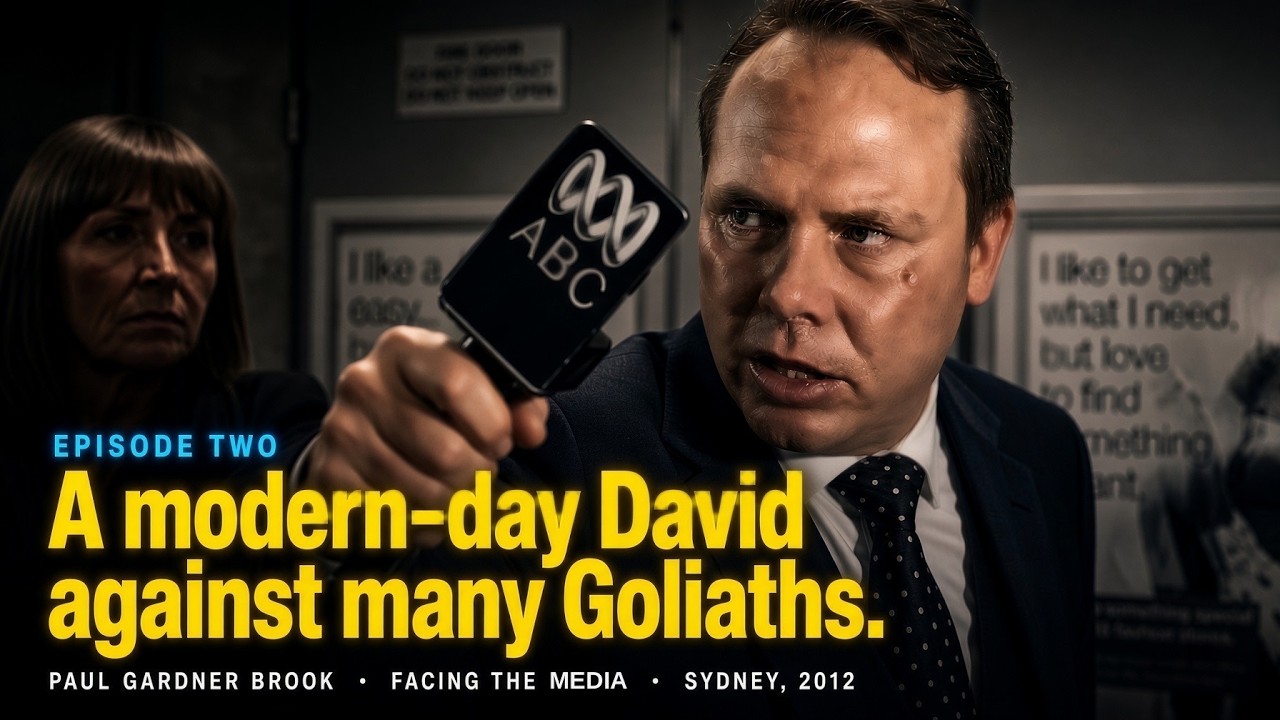 Watch on YouTube · 26:32 ▶
Sources & citations →
Read the full written account →
Watch on YouTube · 26:32 ▶
Sources & citations →
Read the full written account →
A cooperating witness whose evidence, when it mattered most, was repeatedly preferred by the courts over that of the powerful people he testified against — and upheld all the way to the High Court of Australia. What follows is drawn entirely from official court judgments, commission reports and regulatory registers, each linked to its source.
Watch on YouTube · 26:32 ▶
Sources & citations →
Read the full written account →
In the corruption inquiry that exposed the Mount Penny coal scandal, the Independent Commission Against Corruption relied on Mr Brook's evidence and assessed it directly in its report to Parliament.
The Commission formed a favourable view of Mr Brook and his evidence; he gave his evidence in a slow and careful way, and in a manner that was designed to be generally honest and accurate. There were numerous instances where Mr Brook gave evidence that was against his own self-interest. Even so, there were times when Mr Brook was hesitant in telling the full story, possibly as a matter of self-preservation.Commissioner the Hon. David Ipp AO QC — ICAC Operation Jasper report, July 2013
Where his account conflicted with that of the Obeids, the Commission generally preferred Mr Brook's evidence. It did not recommend that consideration be given to his prosecution for any offence.
ICAC · Operation Jasper ↗In the competition proceedings brought by the ACCC against the Cascade Coal directors, the Court weighed Mr Brook's testimony against the documentary record and against the accounts of opposing parties.
For the most part, his evidence was entirely consistent with the documentary record … Overall, I consider that his evidence was essentially reliable.Foster J — ACCC v Cascade Coal Pty Ltd (No 3) [2018] FCA 1019
The Court preferred Mr Brook's evidence over that of the opposing directors — a second, independent judicial validation of his account.
Federal Court · [2018] FCA 1019 ↗Mr Brook was formally vetted and cleared by the Australian Securities and Investments Commission as an Authorised Representative (No. 001282075, 2020–21) — an appointment that requires meeting the regulator's “Fit and Proper” person standard.
ASIC Registers ↗Following the judge-alone trial, Justice Fullerton convicted Edward Obeid, Moses Obeid and Ian Macdonald of conspiracy to commit misconduct in public office and, on 21 October 2021, sentenced each to prison. In assessing the gravity of the corruption, her Honour found:
I am satisfied, for that complex of reasons, the objective seriousness of the conspiracy was of the highest order.Fullerton J — R v Macdonald; R v Edward Obeid; R v Moses Obeid (No 18) [2021] NSWSC 1343; (2021) 394 ALR 125; (2021) 292 A Crim R 506
Ian Macdonald was sentenced to 9 years and 6 months' imprisonment (non-parole period 5 years 3 months); Edward Obeid to 7 years (non-parole 3 years 10 months); and Moses Obeid to 5 years (non-parole 3 years).
Read the sentencing judgment — [2021] NSWSC 1343 (PDF) ↗ NSW Caselaw ↗In November 2021 the ABC's flagship investigative program Four Corners examined the Obeid family's dealings in the episode “Obeid Inc.”, reported by Angus Grigg under Executive Producer Sally Neighbour. Mr Brook was interviewed as a key witness. The ABC subsequently published an editor's note clarifying the nature of his cooperation:
The men Mr Brook testified against were convicted in the NSW Supreme Court in 2021; their appeals were dismissed by the Court of Criminal Appeal and, on 4 February 2026, unanimously dismissed by a full seven-member bench of the High Court of Australia — permanently upholding their convictions for conspiracy to commit misconduct in public office, and exhausting the appellate chain at every level.
The corruption Mr Brook helped expose is now a matter of settled law, affirmed by the nation's highest court. The account the courts preferred has been vindicated in full.
Read the judgment — Obeid v The King [2026] HCA 1 (PDF) ↗ High Court of Australia ↗A cooperating witness — never a defendant. Throughout every proceeding, Mr Brook gave evidence as a cooperating witness. He was never a defendant, never an appellant, and never a person against whom any adverse finding was made — at any stage, by any court or commission.
Independently corroborated. The integrity of Mr Brook's testimony was tested against contemporaneous records. During Operation Jasper the Commission cross-referenced his oral evidence with a folder of internal Lehman Brothers emails and digital archives (Exhibit J-16); emails from his Lehman Brothers account, dated 3 and 4 July 2008, independently corroborated the timeline and transparency of his professional inquiries.
Corroborated by public-record audio — and preferred over a titan of the law. On the central contested question — who introduced Mr Brook to the Cascade Coal side — Mr Brook's sworn evidence was that the Obeid family facilitated the introduction to John McGuigan, a prominent Sydney investor and solicitor and former global chairman of Baker & McKenzie, who was himself the subject of a corrupt conduct finding in the Jasper report. A recorded conversation published by ABC News captures Moses Obeid, at 15:09, saying: “…John [McGuigan] said to me on the phone this morning…” — public-record audio of direct dealings between the two, at odds with testimony from the Cascade side that there were no such dealings with the Obeids; accounts the Commission and the Federal Court did not accept, preferring Mr Brook's evidence. When the Federal Court weighed the two accounts, it preferred Mr Brook's evidence to Mr McGuigan's — the ICAC Inspector himself recording that Foster J “upheld Mr Brook's credibility, preferring his evidence to that of Mr John McGuigan”. Mr Brook's own words: “Moses Obeid introduced me to John McGuigan. I will go to my grave on that.” ABC News · the recorded conversation ↗ ICAC Inspector · Special Report 19/01 ↗
Self-funded, by principle. Though eligible to apply for taxpayer-funded legal assistance — as other witnesses did — Mr Brook declined it and funded his own representation, on the view that, as a non-resident, it would be improper to draw on the public purse.
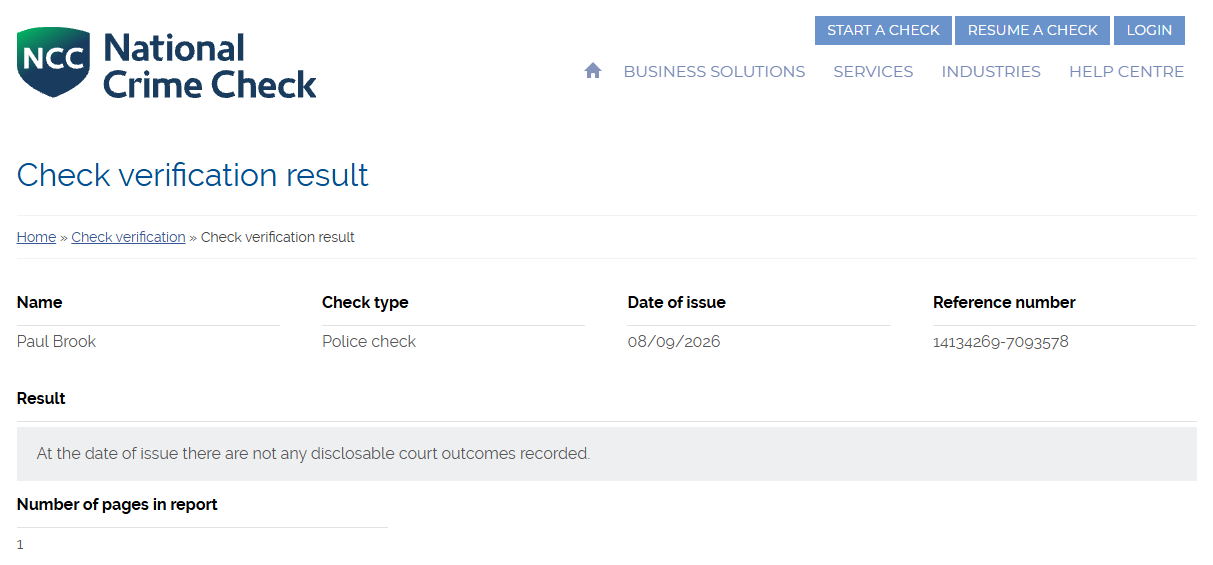
Discharged, never charged. At the conclusion of his evidence he was formally discharged from his summons. He has never been cautioned or charged with any offence, in any jurisdiction, and was not referred to the Director of Public Prosecutions. A Nationally Coordinated Criminal History Check conducted through the Australian Criminal Intelligence Commission records zero disclosable court outcomes — no criminal history.
Every statement on this page is drawn from official government, judicial and regulatory sources, each linked above. References to findings, convictions or proceedings are provided as factual public record and are not intended to impute any conduct to any third party beyond the findings of the relevant court or commission.
The Obeid inquiry did not only test Mr Brook's evidence — it exposed the network of associates around Moses Obeid whose documents and claims were deployed against the witness. Every line below carries exactly what the record supports, with its source. Sworn evidence and contemporaneous records are drawn solid; Mr Brook's own account is drawn dashed, and labelled as his account.
RecordHector Ekes — Moses Obeid. The SMH's own profile described Ekes as “a close friend of Moses Obeid” (14 Nov 2012), and its earlier McGurk reporting recorded that Ekes “has also acted for Moses Obeid” (11 Sep 2009). Ekes knew Mr Brook independently: the two formed the advisory firm Brook & Ekes, which never traded — a matter of sworn record. Ekes died in September 2024.
SMH, 14 Nov 2012 ↗SMH, 11 Sep 2009 ↗
RecordArlo Selby — Moses Obeid. A longtime associate of Moses Obeid who admitted property dealings with him in evidence — and the man who introduced Mr Brook to Moses Obeid at the Wentworth Hotel in 2008. Nine years after the hearings, the SMH's post-conviction retrospective still described Moses Obeid as Selby's “associate”.
Public inquiry transcript, 27–28 Nov 2012 (PDF) ↗ABC News, 26 Nov 2012 ↗SMH, 21 Jul 2021 ↗Daily Telegraph, 27 Nov 2012 ↗
RecordSelby — the January 2011 statement. Selby signed a detailed five-page statement setting out the Obeid family's coal-licence plans — including that the outcome of the tender was “already guaranteed” because the minister was “in on the deal” — before seeking to distance himself from it in the witness box, under warning of contempt. After the convictions, the SMH's 2021 retrospective recorded that the statement “outlined the murky dealings of his associate Moses Obeid”, including the plan for Mr Fang to act as a “front for the Obeids” — the deal the courts later found was rigged in the Obeids' favour. The Daily Telegraph reported the same day that Selby “probably didn’t write it himself” — a point turning on his knowing how to punctuate “I’ll”, which the statement “repeatedly spelled ‘ill’”. The statement was Exhibit J-24 at the public inquiry; the original is held.
SMH, “Obeids and the infamous Mr Fang”, 27 Nov 2012 ↗SMH, 21 Jul 2021 ↗Daily Telegraph, 27 Nov 2012 ↗
RecordPeter Tunks — the statement. Selby's own sworn evidence was that Tunks “wanted to use it to threaten people” and to recover money from Mr Brook “or even indeed the Obeids”; that the statement had been “signed under duress”; and that a jailed underworld figure — named in the Daily Telegraph’s account as Tony Taylor, “threatening him over the phone from his jail cell” — had been pressing him over the statement, while Mr Tunks “had offered him ‘inducements’ to make the statement to obtain money from Mr Brook”. Asked what the threats were — “What violence? Break your arms? Kick you in the shins? Stab you?” pressed Mr Brook's barrister — Selby answered: “You know, the usual stuff.” Mr Tunks is named here solely as described in Mr Selby's evidence, as reported at the time. Documents heldThe paper trail behind that evidence is held in Mr Brook's files: a claim document produced on Mr Tunks' behalf (12 January 2010) asserting a half-share of a 3% “carry” in the Mt Penny and Yarrawa projects, and Mr Tunks' own email of 5 January 2011 — “my intention is to enforce my share value in these coalmines… on a legal basis” — sent six days before Selby signed the statement.
SMH, “Obeids and the infamous Mr Fang”, 27 Nov 2012 ↗ABC News, 26 Nov 2012 ↗Daily Telegraph, 27 Nov 2012 ↗
RecordThe statement — Mr Brook. “This was a blackmail document,” Mr Brook told the inquiry under oath: sent, he believed, to the Obeids, with a copy reaching him through a third party. The Commission put the same alternative to Selby squarely — that either the statement was true, or, as the Daily Telegraph reported, “he had lied and was involved in a conspiracy to blackmail former mate Brook”.
Public inquiry transcript, 27–28 Nov 2012 (PDF) ↗Daily Telegraph, 27 Nov 2012 ↗
RecordMr Brook's accountEkes, Selby — the fabricated CV. The effort to discredit Mr Brook did not rest on the statement alone. Its own signatory swore the statement was “signed under duress”; that Mr Tunks “wanted to use it to threaten people” and to recover money from Mr Brook; that a jailed figure had threatened him to produce it; and the Commission itself put to Selby that the alternative to the statement being true was that he had joined a “conspiracy to blackmail” his former mate (edges 3–5 above). Against that documented backdrop, Mr Brook’s account is straightforward: as the first ICAC raids on the Obeids began and the Selby statement was already in circulation, a fabricated CV was posted on social media to destroy his standing as a witness. No commission or court has ruled on the CV itself — that remains his account — but it is of a piece with a coordinated campaign whose other instruments are established on oath. And it failed in its purpose: the very tribunals it was meant to influence preferred Mr Brook’s evidence at every stage — ICAC in 2013, the Federal Court in 2018, and the convictions upheld by the High Court in 2026.
RecordMr Brook's accountEkes — the SMH profile. The profile itself reports the souring of the Ekes venture and the $50,000 Monaco allegation that came with it — an allegation Mr Brook rejects outright (record). His published statement of 29 October 2020 records that Ekes spoke to the newspaper: “I told him I was very disappointed at what he told SMH” (his account).
SMH, 14 Nov 2012 ↗
RecordMr Brook's accountTroy Dann — the SMH profile. The profile quotes Dann directly: “He was a lot of talk but I found him to be quite shady” (record). The conduct behind the acquaintance runs the other way. Mr Brook and Mr Dann met at a café at the Edward Street end of the Queen Street Mall in Brisbane; Mr Dann said he was broke, and Mr Brook walked across to the Bank of Queensland, withdrew $5,000 and gave it to him — a gift, never repaid because it was never asked back. Separately, he looked at Mr Dann's business ventures and withdrew his interest because, on examination, they did not stack up. Mr Dann telephoned from Hong Kong in 2016 to apologise for a false statement to the paper, and the two reconciled; when Mr Dann approached him again in 2026 wishing to do business, Mr Brook declined. Money given to a man in difficulty with no expectation of return, and a commercial judgement kept independent of it, are the opposite of the quoted word (his account).
SMH, 14 Nov 2012 ↗
RecordThe article — the witness. “Fact and fiction blur the lines in a deal-maker's life” was published on 14 November 2012 — days before Mr Brook entered the witness box in public. The courts then spent the next fourteen years preferring his evidence: ICAC in 2013, the Federal Court in 2018, and the convictions he helped secure upheld by the High Court in 2026 — the findings set out above on this page.
SMH, 14 Nov 2012 ↗
The Obeids did not act alone. In its Operation Jasper report of July 2013, the Independent Commission Against Corruption found that five principals of Cascade Coal — Travers Duncan, John McGuigan, John Atkinson, John Kinghorn and Richard Poole — had each engaged in corrupt conduct in concealing the Obeid family’s interest in the Mount Penny coal tenement from the NSW Government, and recommended that the Director of Public Prosecutions consider prosecuting them for fraud and company-law offences.
On the witness, the same report runs the other way. In setting out the admissible evidence available to the DPP against those men, the Commission listed, in each case, “the evidence of Mr Brook.” His testimony formed part of the basis on which they were referred. And when it turned to Mr Brook himself, the Commission was unequivocal:
The powerful were referred — in part on his evidence. The witness was cleared.
The corruption ran from a minister of the Crown, through the Obeid family, to the businessmen who concealed their interest in the coal tenement. Mr Brook gave evidence bearing on all of them — and the Commission relied on that evidence to refer the Cascade directors, while declining to prosecute him. Solid lines record ICAC findings and court outcomes; the amber line marks the witness’s own evidence, relied on by the Commission.
Between 2015 and 2018, articles in The Australian — drawing on the Obeids' litigation and a complaint by Cascade Coal investors — raised three questions about Mr Brook's credibility. Each was examined by the proper authority. Here is each question, and the record's answer, drawn from the ICAC Inspector's Special Report 19/01 — hosted on this site in full — the Commission's reports, and the judgments above.
The approach, first — why immaterial matters went uncontested. Mr Brook's conduct at the compulsory examination reflected a considered and conventional strategy for a witness before such an inquiry: that a compulsory private examination is not the forum in which to litigate immaterial character allegations — that those seeking to discredit a witness will “play the man”, and that the witness must keep his focus on the material evidence. On that basis Mr Brook did not contest peripheral allegations — the online CV among them — and directed his evidence to the substance of the corruption before the Commission. That the Commission then assessed that evidence as “designed to be generally honest and accurate” reflects the discipline of that approach. This is Mr Brook's account of the strategy he adopted.
The weight of the evidence, first — the context the headlines omit. From the compulsory examination of March 2012 to the criminal trial's witness box in October 2020, Mr Brook gave evidence for the better part of a decade: across two ICAC operations (his evidence occupies four chapters of the Jasper report and one of Credo's), a public inquiry that ran forty-five days, the ACCC's Federal Court proceedings, and the criminal trial of a former minister and the Obeids. He gave it against a former minister of the Crown, the state's most powerful political family, and the Cascade Coal investors — described in the very article that attacked him as “some of the wealthiest businessmen in NSW” — over licences whose expropriation was valued by The Australian at more than $300 million. Among them was John McGuigan, former global chairman of Baker & McKenzie: when their accounts collided, the Federal Court preferred Mr Brook's evidence to his. The ICAC found that “those negotiating on behalf of Cascade Coal, including Messrs McGuigan, Poole and Atkinson knew” that “the Obeids were the party with whom they were entering into a joint venture” — and its corrupt conduct findings against Cascade figures survived their appeals. The men Mr Brook testified against carried their challenges through every available forum, to the High Court of Australia twice — Duncan v ICAC in 2015, Obeid v The King in 2026 — and the findings stood, every time. That is the context in which the Commission's single caveat — that there were moments he was “hesitant in telling the full story, possibly as a matter of self-preservation” — should be read: a lone witness, self-funded on principle, measuring his words against opponents with every resource to make him regret them. The Commission itself said the rest: numerous instances where Mr Brook gave evidence that was against his own self-interest.
1 · The CV claims. At a compulsory private examination in March 2012, Mr Brook made admissions concerning false claims as to qualifications that had appeared in an online CV, found by counsel assisting through an online search — including a claim to a law degree. The answer is that the Commission knew all of it, and weighed it. The ICAC Inspector, examining the complaint that this material should have been disclosed: “all the findings made by the ICAC to which Brook's evidence was relevant were supported by evidence other than that of Mr Brook and could have been made independently of his evidence, so I consider it improbable that disclosure would have made any difference.” With those admissions before it, the Commission still assessed his evidence as “designed to be generally honest and accurate”, against his own self-interest in numerous instances — and the Federal Court in 2018, in the Inspector's words, “upheld Mr Brook's credibility”. His verified qualifications — the La Trobe Bachelor of Business, and part-time law studies at Monash that he did not complete — are documented in certified academic records; he claims no law degree. There was, in any event, no incentive to invent them: by 2012 Mr Brook had an established career in international investment banking behind him, and a false online CV added nothing to a record that did not need it. It is Mr Brook's account that the online CV was not his work, posted amid the campaign described in the map above.
ICAC Inspector · Special Report 19/01 (PDF) ↗The Australian, 10 Nov 2017 ↗
2 · The medical report. ICAC held a psychiatrist's report from November 2012 noting a head injury and memory difficulties, not disclosed to defence teams — “kept secret”, as The Australian put it. The answer begins with a fact the headlines omit: the report reached the Commission because it was supplied on Mr Brook's behalf — his own side provided it. The Inspector examined the non-disclosure and found it “did not amount to 'abuse of power, impropriety and other forms of misconduct' or 'maladministration' on the part of the ICAC or any officer”, noting that disclosure would improbably have made any difference. The NSW Supreme Court separately rejected the Obeids' procedural-fairness argument. And with all of it public from 2015 onward, the criminal trial proceeded, the convictions followed, and seven High Court judges upheld them unanimously.
ICAC Inspector · Special Report 19/01 (PDF) ↗
3 · The “secret deal” and the “cocaine addict” claim. In 2015 the Obeids' lawyers alleged ICAC had made “a secret deal” to “go easy” on Mr Brook, and pointed to a redacted claim in Arlo Selby's statement that he was “a cocaine addict”. The answer is in the Commission's own report, on the very witness that claim came from: “Mr Selby was an unreliable witness… so unreliable that the Commission has taken the view that his evidence should be put to one side.” The alleged deal appears in no finding of any court, commission or inspector; the ABC's editor's note above records that Mr Brook cooperated of his own free will and in good faith and was never charged; he was formally discharged and never referred to the DPP.
ICAC Inspector · Special Report 19/01 (PDF) ↗
4 · The “financial fraud” claim. No court, commission or inspector has ever made any finding — of fraud, or of any offence — against Mr Brook. He gave his evidence as a cooperating witness, never as a defendant: he was formally discharged from his summons, never charged, and never referred to the Director of Public Prosecutions. A Nationally Coordinated Criminal History Check records zero disclosable court outcomes — no criminal history of any kind. And in 2020 he was independently vetted and cleared by the Australian Securities and Investments Commission to its “Fit and Proper” person standard as an Authorised Representative (No. 001282075) — a clearance the regulator does not grant where there is any history of financial wrongdoing. The suggestion appears in no finding of any court or commission; it originates as an untested assertion in the litigation of the parties his evidence helped convict, and is contradicted by every official record on this page.
ICAC Inspector · Special Report 19/01 (PDF) ↗ASIC Registers ↗
When the theory was finally tested. The “secret deal” claim was not only aired in the press — it was pleaded in court. When the Obeids sued the Operation Jasper Commissioner, David Ipp, for misfeasance in public office, their senior counsel advanced, in the statement of claim, the same accusations: that Mr Brook had an undisclosed arrangement with the Commission and was an unreliable witness whose evidence had been manipulated to a predetermined outcome. The allegations were withdrawn before trial. The action failed — the claims were dismissed, and the plaintiffs were ordered to pay Mr Ipp's costs on the indemnity basis, a bill later fixed at more than $5 million. In its costs judgment the Supreme Court described the abandoned allegations as “unmaintainable and irresponsibly made”. And in October 2018 the New South Wales Bar Council found that counsel's conduct in advancing them amounted to unsatisfactory professional conduct, reprimanded him, and ordered him to apologise to Mr Ipp. The material from which the theory was assembled remains on the public court record for anyone who cares to read it; the conclusion of the courts and of the profession's own regulator was that there had never been a reasonable basis for the accusations built upon it.
Obeid v Ipp [2016] NSWSC 1376 ↗[2017] NSWSC 271 · costs ↗[2020] NSWSC 1329 · gross-sum costs ↗SMH · 31 Oct 2018 ↗
The allegations summarised above are described as they were reported at the time, with their sources; the answers are drawn from the ICAC Operation Jasper report, the ICAC Inspector's Special Report 19/01, and the judgments linked on this page. Nothing here imputes conduct to any person beyond the findings of the relevant court, commission or inspector.
No. In its Operation Jasper report of July 2013, ICAC stated it was “not of the opinion that consideration should be given to obtaining the advice of the DPP with respect to the prosecution of Mr Brook for any criminal offence.” He was never charged, and his evidence was preferred by ICAC in 2013, the Federal Court in 2018 and the High Court of Australia in 2026.
In the same report, the Commission found that Travers Duncan, John McGuigan, John Atkinson, John Kinghorn and Richard Poole had each engaged in corrupt conduct in concealing the Obeid family’s interest in the Mount Penny coal tenement from the NSW Government, and recommended the Director of Public Prosecutions consider prosecuting them for offences under the Crimes Act 1900 and the Corporations Act 2001.
In each of those DPP referrals, the Report lists the admissible evidence as including “the evidence of Mr Brook.”
Edward Obeid Sr, Moses Obeid and the former minister Ian Macdonald were convicted, and their convictions were upheld by the High Court of Australia in 2026. Mr Brook, the cooperating witness, was never charged.
No. No court, commission or inspector has ever made any such finding against him. He was a cooperating witness, never a defendant — formally discharged, never charged, never referred to the DPP. A Nationally Coordinated Criminal History Check records zero disclosable court outcomes, and in 2020 he was vetted and cleared by ASIC to its “Fit and Proper” person standard (Authorised Representative No. 001282075). Any suggestion to the contrary appears in no official finding.
Solid lines record sworn evidence given at the ICAC public inquiry or matters of contemporaneous public record, each cited. Dashed lines present Mr Brook's own account and are labelled as such; no commission or court finding is claimed for them. Nothing on this page imputes any conduct to any person beyond the findings of the relevant court or commission; allegations described in evidence remain allegations, and references to individuals record only what was said in evidence or published reporting at the time. Mr Peter Tunks appears solely as described in Mr Selby's sworn evidence as reported; no other identification is made or implied.